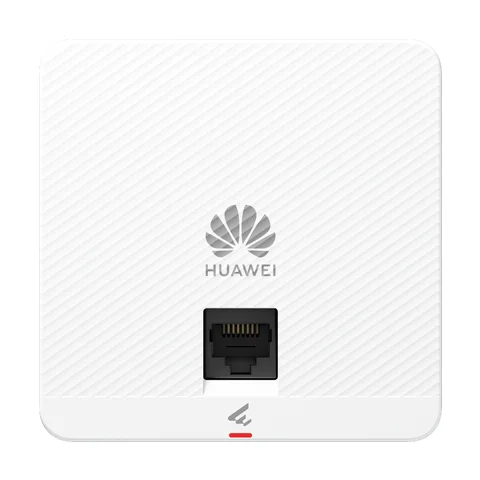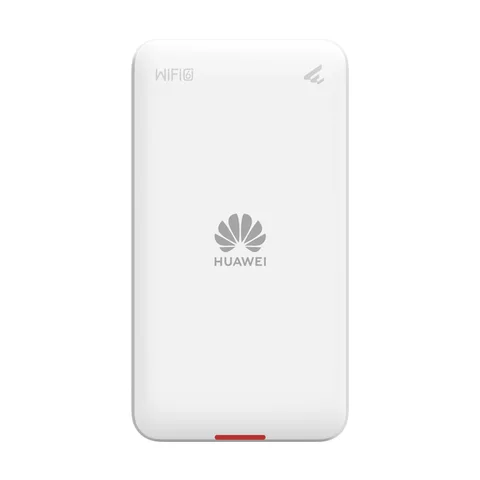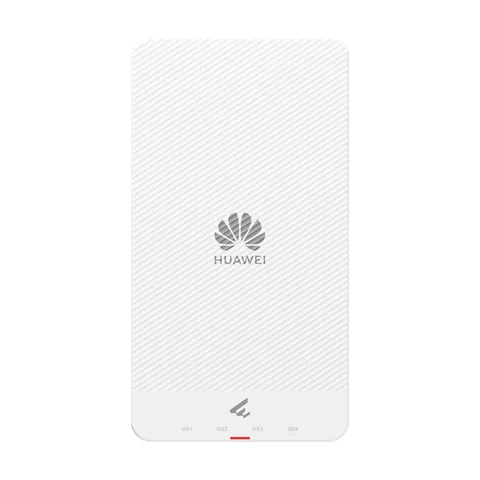
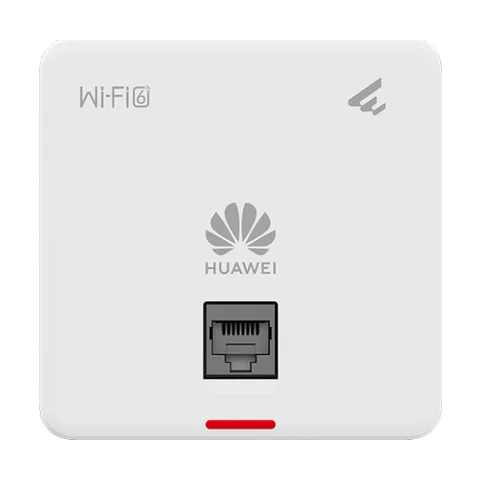
Access Point Huawei AP160
Modelo AP160
Ver detalhes
Redes e telecom
 Roteadores e Wi-FiRoteadores, access points e antenas
 SwitchesGigabit, PoE e gerenciáveis
 OLT, ONU e conversoresGPON, ONU e conversores de mídia
 Cabos de fibra ópticaDrop, ASU e cabos ópticos
 Cabos e conectores de redeCat5e, Cat6, patch cords e RJ45
 Conectividade ópticaConectores, splitters, DIO e caixas
 Ferramentas e testesFusão, clivagem e medição
 Racks e infraestruturaRacks, ferragens e ancoragem
 Energia e nobreaksNobreaks, baterias e inversores
Informática
Novazul Cursos: segurança eletrônica e redes
AP673H(11be indoor,2+2+4 tri-band,smart antenna,USB)
Preço, prazo e disponibilidade são informados no atendimento comercial. Para comprar, solicite o cadastro da sua empresa.
AP673H(11be indoor,2+2+4 tri-band,smart antenna,USB)
| Linha | SME Network / WLAN / iGuard |
|---|---|
| Part number | 50089373 |
| Fim de comercialização (EOM) | 2031-06-30 |
| Wi-Fi standard | Wi-Fi 7 |
|---|---|
| Optimal Signal Distance (m) | 30m |
| Recommended Number of Access Users | 300 |
| Device Rate | 13.66Gbps |
| Installation Type | Wall,Ceiling (Solid Wall/Gypsum Board/Spring Tee/Flat-Edge T-Rail/Channel Rail/Beam/Threaded Rod),Junction Box (86 mm/1-Gang 120 mm/Octagonal/2-Gang 120 mm) |
| Dimensions without packaging (H x W x D) [mm(in.)] | 59.5 mm x 220 mm x 220 mm (2.34 in. x 8.66 in. x 8.66 in.) |
| Dimensions with packaging (H x W x D) [mm(in.)] | 110 mm x 286 mm x 274 mm (4.33 in. x 11.26 in. x 10.79 in.) |
| Weight without packaging [kg(lb)] | 1.54 kg (3.40 lb) |
| Weight with packaging [kg(lb)] | 2.18 kg (4.81 lb) |
| CPU | 4-core, 1.0 GHz |
| Memory | DDR4 1 GB |
| Power supply mode | PoE,DC power adapter |
| Storage | NAND Flash 512 MB |
| Rated input voltage [V] | DC: 48 V PoE: 802.3bt/at |
| Input voltage range [V] | DC: 43.2 V to 57.6 V PoE: 802.3bt/at |
| Service port surge protection | PoE port: Differential mode (48 V-RTN): 0.5 kV (1.2/50 us, 42 ohms), criterion B Common mode (8 wires to ground): 4 kV (1.2/50 us, 42 ohms), criterion B |
| Types of fans | None |
| Maximum number of physical ports on the entire device | 10GE optical (SFP+) x 1, GE/2.5GE/10GE auto-sensing 2.5GE (RJ45) x 1, 100M/1000M/2.5GE auto-sensing GE (RJ45) x 1, 10M/100M/1000M auto-sensing |
| Long-term operating temperature [°C(°F)] | –10°C to +50°C (14°F to 122°F) (From 1800 m to 5000 m [5905.51 ft. to 16404.20 ft.], the maximum ambient temperature decreases by 1°C [1.8°F] for every 300 m [984.25 ft.] increase in altitude.) |
| Storage temperature [°C(°F)] | –40°C to +70°C (–40°F to +158°F) |
| Long-term operating relative humidity [RH] | 5% RH to 95% RH, non-condensing |
| Long-term operating altitude [m(ft.)] | –60 m to +5000 m (–196.85 ft to +16404.20 ft) |
| Atmospheric pressure [kPa] | 53kPa - 106kPa ETSI 300 019-2-3 |
| Ground | Floating ground |
| USB | Supplies power of 2.5 W or 5 W. |
| Radio number | 3 |
| MIMO spatial streams | Triple-radio mode: Radio 0 (2.4 GHz): 2x2 Radio 1 (5 GHz-H): 2x2 (high frequency band) Radio 2 (5 GHz-L): 4x4 (low frequency band) Triple-radio mode (default): Radio 0 (2.4 GHz): 2x2 Radio 1 (5 GHz): 2x2 Radio 2 (6 GHz): 4x4 Dual-radio mode: Radio 0 (2.4 GHz): 2x2 Radio 1 (5 GHz): 4x4 |
| Wi-Fi standard | 2.4 GHz: 802.11b/g/n/ax/be 5 GHz: 802.11a/n/ac/ac Wave 2/ax/be 6 GHz: 802.11a/ax/be |
| Radio interface | Built-in dynamic-zoom smart antennas, which can work in two modes on a per-packet basis through algorithm control: 170-degree omnidirectional coverage mode and 60-degree anti-interference mode |
| Antenna gain | 2.4 GHz: 4 dBi/chain (peak gain) 1 dBi (combined gain) 5 GHz: 5 dBi/chain (peak gain) 2 dBi (combined gain) 6 GHz: 5 dBi/chain (peak gain) 2 dBi (combined gain) |
| Maximum transmit power | Triple-radio mode: 2.4 GHz: 20 dBm/chain 5 GHz: 19 dBm/chain 6 GHz: 19 dBm/chain Dual-radio mode: 2.4 GHz: 20 dBm/chain 5 GHz: 20 dBm/chain |
| Advanced Cellular Coexistence (ACC) | Supported |
| MTBF [year] | 114.3 |
| MTTR [hour] | 2 |
| Maximum power consumption [W] | 24.8 W (excluding USB) |
| Maximum heat dissipation [BTU/hour] | 80.39 |
| 802.3bt power supply description | At the power supply level of 802.3bt Class 8, no function is restricted. At the power supply level of 802.3bt Class 6, no function is restricted. |
| 802.3at power supply description | When the power supply mode is negotiated to 802.3at and the USB port is idle, the device functions are not restricted. When the USB port uses 2.5 W power supply, the GE electrical port is unavailable and only one of the 2.5GE electrical port and 10GE optical port is available at the same time. In addition, the radio mode can only be set to 2.4 GHz (2x2) + 5 GHz (2x2) + 6 GHz (2x2), 2.4 GHz (2x2) + 5 GHz-H (2x2) + 5 GHz-L (2x2), or 2.4 GHz (2x2) + 5 GHz (4x4). In triple-radio mode, the maximum bandwidth values supported for the 2.4 GHz, 5 GHz, and 6 GHz radios are 40 MHz, 80 MHz, and 160 MHz, and the combined power of each radio is 20 dBm. In dual-radio mode, the maximum bandwidth of the 2.4 GHz radio is 40 MHz (combined power: 20 dBm), and that of the 5 GHz radio is 80 MHz (combined power: 23 dBm). When the USB port uses 5 W power supply, the GE electrical port is unavailable and only one of the 2.5GE electrical port and 10GE optical port is available at the same time. In addition, the radio mode can only be set to 2.4 GHz (2x2) + 5 GHz (2x2), 2.4 GHz (2x2) + 5 GHz-H (2x2), or 2.4 GHz (2x2) + 5 GHz (4x4), with the maximum bandwidth of 20 MHz supported for the 2.4 GHz radio and 80 MHz supported for the 5 GHz-H/5 GHz radio. In 2.4 GHz (2x2) + 5 GHz (4x4) mode, the combined power of the 2.4 GHz radio is 20 dBm and that of the 5 GHz radio is 23 dBm. Note: When the 5 W USB output is enabled, the third radio is disabled in triple-radio mode. As such, you are advised to set the radio mode to dual-radio or triple-radio (2.4 GHz + 5 GHz + 6 GHz) mode to ensure that the 5 GHz radio can use full-band channels. |
| DC power supply description | No function is limited. |
| Operating frequency band | 2.4GHz,5GHz,6GHz |
| Frequency stability [ppm] | +/-20 |
| Maximum channel bandwidth [MHz] | Triple-radio 6G mode: Radio 0 (2.4 GHz): 40 MHz Radio 1 (5 GHz): 80 MHz Radio 2 (6 GHz): 320 MHz Triple-radio dual-5G mode: Radio 0 (2.4 GHz): 40 MHz Radio 1 (5 GHz-H): 80 MHz Radio 2 (5 GHz-L): 160 MHz Double-radio mode: Radio 0 (2.4 GHz): 40 MHz Radio 1 (5 GHz): 160 MHz |
| Storage environment | ETSI EN 300 019-1-1 Class 1.2 Note: - The product has a valid storage period of one year. - The valid storage period refers to the period during which the product maintains the required quality when stored with packing materials in an environment that meets the preceding requirements. |
| First supported version | V600R025C01 |
|---|